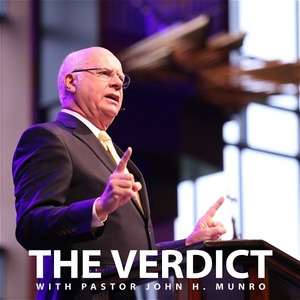
Today on the Verdict with Pastor John Monroe. I'm saying to you to trust God, to trust God in the tough times. If it's true that God is sovereign, if it's true that He knows the end of the story from the beginning, doesn't it make sense to trust Him? Welcome to the Verdict, featuring the Bible teaching of Pastor John Monroe. Each day brings new challenges we didn't see coming, and everyone, including followers of Christ, can feel overwhelmed at times.
So, what are we supposed to do?
Well, today we're going to begin tackling this question in a practical biblical series called "With Wings Like Eagles." To get us started, here's Pastor John Monroe with a message titled "Trusting God in Tough Times." Have you ever seen an eagle flying? What freedom, power, and perspective it has! Do you sometimes wish that you could soar past your troubles and the hardships of everyday life? Today, we begin a new series. I am very excited about it.
I've called it "With Wings Like Eagles." It comes from the Old Testament book of Isaiah, a book of beauty, of tremendous poetry, as well as promises and warnings. Our central scripture in this new series is Isaiah 40:31. But they who wait for the Lord shall renew their strength; they shall mount up with wings like eagles; they shall run and not be weary; they shall walk and not faint. Join me today as we begin this fascinating series. We'll learn the importance of being God-centered and trusting God in tough times.
Struggles and challenges come to every single one of us, and when they come, they may defeat us, they may discourage us, they may render us very bitter. Or, through the challenges, through the struggles, we may be renewed in strength and mount up with wings like eagles. That's what we desire, isn't it? The answer to the challenges and the struggles of life is this: is not to be circumstance focused, is not to be self focused, but is to be God centered. Not just for an hour or two on a Sunday.
But for every day, really for every minute of the day, that we are God-centered, then says Isaiah, when that happens, when you wait on the Lord, something wonderful is going to happen. You're going to soar with wings like eagles.
Now that does not eliminate the challenges and the problems of life that are there, but you will be you will face them with a supernatural strength, and they will not defeat you.
So in this series, I'm going to challenge you to trust God in ways perhaps you've never done before, perhaps in seemingly impossible situations, so that in the tough times of life, and they come, some of you are in them right at this moment. Most of you know exactly what I'm talking about when I talk about the struggles and the trials of life. That when they come. You will wait on the Lord, and as you do that, you're going to soar with wings like eagles. You're going to run and not be weary, and you will walk and not faint.
Anyone here weary? Anyone finding the Christian life tough going? Anyone hearing that, feeling that sometimes you're just holding on, as it were, with your fingernails, and you're not sure if you can make it through another day? Isiah, the Old Testament prophet, I would argue, possibly the greatest of the Old Testament prophets, has got something to say to us because he's writing to people who have gone through tough times, a people who have experienced captivity, a people who will experience captivity, and yet, well, they will understand something about God.
Now, let's stand and read the Word of God. My text today primarily is from Isaiah 44, verses six through eight, and we're going to read it together. Thus says the Lord, the King of Israel, and his Redeemer, the Lord of Hosts. I am the first, and I'm the last. Besides me, there is no God.
Who is like me? Let him proclaim it. Let him declare and set it before me, since I appointed an ancient people. Let them declare what is to come and what will happen. Fear not, nor be afraid.
Have I not told you from of old and declared it? And you are my witnesses. Is there a god besides me? There is no rock. I know not any, Amen.
Please proceed.
Now I'm not going to deal with the context of Isaiah. I'm going to deal with that at some other time. But if you have your Bibles, open it to Isaiah because, as well as looking at Isaiah 44, we're going to look at other passages in this amazing letter. Two parts to Isaiah: chapters one through 39, and then 40 through 66, and then 40 through 66. We have some of the greatest literature.
Surely, some of the greatest truths ever written, and we're going to dive into some of that. I'm saying to you to trust God, to trust God in the tough times. Now, why would you trust God? Isaiah is telling us in the verses we've read. You trust God because He is supreme.
Notice how He describes God. In verse six of Isaiah forty-four, thus says the Lord: Who is he? He's the King of Israel. Not only the King of Israel; he's the King of Kings and Lord of Lords. He's the Redeemer.
He's the Lord of Hosts, the Lord of Armies, the Mighty One. No one can stand against him. I am the first and the last. What's Isaiah saying? This is the Eternal God.
He's incomparable. Yes, you've got many, many idols. I understand that says says Isaiah, and he's going to deal with them in a brilliant way. But remember this: there's only one true God. Notice what he says at the end of verse six: "I'm the first and the last.
Besides me, there is no God." Verse seven: Who is like me? Rhetorical questions. Let him proclaim it. Do you know anyone or anything like God? Answer: Of course not.
End of verse eight. Again, the rhetorical question to undermine the point: Is there a God besides me? Is there anyone like God that you know of? I know you've got your own little gods. You've got this—all kinds of things at the center of your life.
But is there anyone who remotely comes close to this God? There is no rock. I know not any. We are saying that God is supreme. He's higher.
Do you remember the first commandment? First of the ten commandments: "You shall have no other gods before me." God is so important. God is so unique. He's so awesome that He must have no competitors, no rivals. No one can come even close.
No gods other than this God. You really want to put yourself at the center of your world. You really want to worship yourself. You really want life to be all about you and your pleasure and your comfort and your success and your family and what you do and your dreams. You really want to do that.
You really want to compete with God. Isaiah is saying, "No, there is no one like Him. Anyone." Or anything at the center of your life, other than God, is an idol.
Now I don't think many of us at home have a little statue, a little actually physical idol that we bow down and worship. But doesn't our very life demonstrate what's important? Here is a man who professes to be a Christian, and the Lord's Day for him is having some convenient little church that he can go to, get it over, tick the box, and then really enjoy life. Imagine if that was your friend. Would you like a friend like that?
So I want to spend fifteen minutes with Susie. I'm going to tell her what a wonderful person is, and then hey.
Well, I'm glad that's over now. Let's get on with life. That would be terribly disrespectful, wouldn't it? Even in a human relationship. Look at verse nine, Isaiah 44: All who fashion idols are nothing, and the things they delight in do not profit.
Their witness is neither seen or known, that they may be put to shame. Who fashions a god or casts an idol that is profitable for what? For nothing. Verse fifteen. It becomes fuel for a man.
He talks about going out and and and getting a tree, a piece of wood, and shaping it and forming it into a god that I can worship. But notice what he says. It becomes fuel for a man. Why is that? Because he takes part of it and warms himself, he kindles a fire and bakes bread.
Also, he makes a god and worships it. He makes it an idol and falls down before it. Half of it he burns in the fire. Over the half he eats meat. He roasts and is satisfied.
Also, he warms himself and says, "Aha, I'm warm. I've seen the fire." And the rest of it he makes into an idol, a god, and falls down to it and worships it. Think of Isaiah's magnificent, brilliant, sarcastic argument. What kind of God have you got? I mean, you worship part of it, you shape it, you bow down before it, you worship it.
But the other part of it, you put in the fire and you burn it and cook your supper from it. What kind of God is that?
So, whatever you have at the center of your life, how good is that? Is that what you're going to turn to in the struggle of life? Your business. I've lost count of the number of men I've met over my life who've come and said to me, "John, I went into the office or the bank or the hospital or wherever it was the other day, and I was told, 'Hey, no job for you. We've reorganized things.
I'm sorry. Goodbye.'" A whole life spent in that, and it's gone. Your health. You worship yourself. You think you're in great physical shape?
You look at yourself in the mirror and say, "Ah, there's a real specimen of a man or a woman." How long is that going to last? Even with the plastic surgery. I mean, how long? A friendship? Who hasn't been betrayed by a friendship?
Anything other than God, as I is saying, is an exercise in futility. These idols can't solve your problems. These things can't help you in a time of crisis. They certainly can't save you. No, your greatest need, your greatest priority, is to be God-centered.
And notice how magnificently. As Isaiah describes God again, verse six, thus says the Lord. In my Bible, it's capitalized. It's a translation of the Hebrew word Yahweh, a word which is so sacred, God's personal name, that the pious Jews to this day will not pronounce it. Here in Israel, you sometimes see the word G-D.
They won't even write the name God.
So holy, this is the Lord. This is God's personal name. Remember when Moses asked God His name? Lord, you want me to go and deliver the people? I mean, when they ask you, who is this God?
What am I going to say? What was your name? And God gives this to our ears, this very strange answer: "I am the Lord. I am." Yahweh, what does it mean? It's really a verb.
I am who I am. That sounds odd, doesn't it? What's your name? I am who I am. What's God doing?
God is doing what you and I couldn't possibly do. God is describing Himself. Not really defining himself. How can you define God? But God is describing Himself exclusively in terms of who He is.
I am who I am. He is the great I am.
Someone asks you, "You meet today.
Well, who are you? How do we describe ourselves? We describe ourselves by our background, by family, by relationships, by work, by ethnicity." We describe ourselves by what we do, but God doesn't derive His being from anyone or anything. He's distinct from His creation. He's independent of His creation.
He's not the created; He is the creator. His being has no beginning. There's no beginning to God. There's no end to God. He is the eternal I am, eternally present.
The God who was, who is, and ever shall be. That blows your mind, doesn't it? An eternal God, yes. The uncaused cause. Notice what Isaiah says here: I am the first and the last.
No one before me, and no one after me. The Alpha and the Omega, we're told in Greek, describing our Lord Jesus, who is God. Of course, I am who I am, the first and the last. One commentator says he he encompasses all of existence from start to finish. Think of this: all of existence, of everything, is encompassed in God from the beginning.
To the end, you think you're someone? Are you going to compare yourself to God? Are you really going to rebel against God? Are you going to put something or someone more important than this God? We're born, we grow old, we die.
But God is eternally Himself. He's self-existent. He's self-sufficient. He doesn't need anyone or anything. He's the inexhaustible God.
I am who I am. God is never in the process of becoming anything else. We do. We change. We say, "Well, I'm going to lose some weight.
I'm going to change. I'm going to." Make the team. I am going to work out. The athlete says. The scholar says.
I am going to study hard. I am going to do this exam. The man who's working hard says, "I am going to try and get this promotion." We're always trying to become something. God's never like that. God's never ever in the process of becoming anything.
Why? He's the great. I am.
Now, doesn't it make sense if you believe that? And Isaiah is telling us over and over again that to trust Him, trust His God. Why? Because He is the supreme God. He's the greatest God.
We sometimes sing, and it's inadequate, but we sing it, isn't it? How great You are. Yes, He is great. No greatness comes near to His. His is unique, separate.
He is the Eternal Lord. Therefore, trust Him. But also, we should trust God not only because He's supreme, because He is the Sovereign. Turn over a few verses to Isaiah chapter forty-six. I find this intriguing.
How Isaiah and if it's a while since you've read it, keep reading Isaiah, particularly chapters forty through sixty-six. Listen to Isaiah in these brilliant verses. Isaiah forty-six verse nine: Remember the former things of old, for I am God, and there is no other. I am God, and there is none like me. Didn't you just say that before, Isaiah?
Why do you keep repeating yourself? That's what sometimes people say to preachers. Why do you keep repeating yourself? Because we're going to keep repeating it until you get the point. And Isaiah is saying, "This is the important point.
This is the all-important point. If you understand this, everything else falls into place." Now, notice verse ten, declaring the end from the beginning, and from ancient times, things not yet done. Saying, "My counsel shall stand, and I will accomplish all my purpose." Oh, is that interesting? This puts God in a different category, doesn't he? Did you know this?
He declares the end from the beginning, and from ancient times, things not yet done. Take your personal story. Take the story of the United States. Take the story of the history of the world. God knows the end from the beginning.
I used to get the magazine, The Economist, and I did a strange thing with it. I would always start at the back and read backwards. Do you see why do you do that?
Well, if you get The Economist, you know at the back of The Economist are obituaries. I love reading obituaries because it summarizes. What's important to people, and the writers in the Economist write brilliant obituaries.
Sometimes of famous people, sometimes of people not so famous, but it describes their life. And so I would read the obituary first and then work backwards. Strange thing to do, isn't it? Be like reading a novel, a kind of a Who Done It, and you read the end and you get the the crime solved before you really know what the crime is. God can do that.
He knows the end from the beginning. Why? Because he's sovereign. He's in control. He not only knows the end from the beginning; he's in control of all things.
Notice. End of verse ten. My counsel shall stand, and I will accomplish all my purpose. There is not one person here who can say that. You can't say you accomplish your purposes.
Yes, you have plans. Yes, you have goals. Yes, you intend to do such and such this week. That's very good. I have certain plans.
I've got certain things in my calendar, but I cannot say I will accomplish all of them with certainty. No. I'm not in control of my life. Do you really think you're in control of your life? Are you really that foolish?
You're in control of your life, are you?
Now, if you've lived any length of time, you know there are forces, there are circumstances totally out of your control, with your family, with your health. You think you are healthy. All it takes—wake up one morning with a slight pain somewhere—the whole of your life has changed. All it takes is one microsecond to be told some devastating news about the loss of a loved one, and your whole life is turned upside down. And what you thought was going to happen.
Or here is the athlete, the great athlete. He's going to play. He's going to. He's planned for the big, big day when he's going to throw the winning touchdown, and everyone's going to say this is the greatest quarterback since fill in the blank. But he's injured, and he thought he could write his own story, but he can't.
But you see, God is in control. God is in control of all of the nations, all of creation, and all of our life. I am not in control of my life. I am not in control of my personal history of my life. But I know this even before I was born.
When I was in my mother's womb many years ago, God knew exactly every detail of the life of John Munro. He knew I was going to be standing in this platform preaching to you. If you told me that as a wee boy, I'd have run a hundred miles. God knows.
Now you say that's a scary thing. Really, do you find it scary? I don't. I find it tremendously comforting. Because I've lived long enough to know that I can make some really bad decisions, and that I can plan.
I have tasks. I like to accomplish things. I like to tick off the sheet and say I've done one, two, three, four, five today, and I'm going to accomplish this this year. But I've lived long enough, and many of you have as well, to know that doesn't really work, does it? And into our life blow unexpected circumstances.
We hit the brick wall. Plans change.
Now, if it's true, if it's true that God is sovereign, if it's true that He knows the end of the story from the beginning, doesn't it make sense to trust Him? This is the verdict, featuring the Bible teaching of Pastor John Monroe. There's still more to hear when John returns in just a moment.
So stay with us. From matters of truth and identity to the subjects of love and grace, our world seems more confused than ever. But to find truth and certainty about who we are and find peace, we must turn our attention away from the world and look to the Word of God. To help you do that, John wrote a booklet titled "Eternal Security: Finding Certainty in a Chaotic World." Through this special resource, John shares his personal testimony along with a careful examination of Scripture to offer us clarity on matters of eternity. Get your copy today by visiting our website at theverdict.org.
While you're there, consider making an investment in this Bible teaching ministry. Whether it's five dollars, fifty dollars, or more, your gift today helps cover the cost of sharing these gospel messages to listeners around the world. And if you haven't already, be sure to subscribe to the Verdict podcast, featuring John's weekly podcast exclusive called Avizandum. It's available wherever you get your podcasts, or simply go to our website. Again, that's theverdict dot org.
The Verdict is a ministry of Calvary Church in South Charlotte. We're located on the corner of Highway Fifty One and Ray Road. If you've been looking for a church home or a community to help you grow in your walk with Christ, we invite you to join us for our Sunday services. For more details about Calvary and our service times, visit theverdict.org.
Now, here's Pastor John Monroe.
Well, what's your verdict? Unless you're a very unusual person, I know you know about tough times. They come to all of us. And you may be going through a tough time right now. I'm encouraging you to put your trust in God.
I'm encouraging you each day to live a God-centered life. I realize that's difficult, but as we've been learning today, remember who God is. He's a great God, and He's good.
So trust Him, and this will transform your perspective.
Next time we'll continue with trusting God in tough times. Thanks for joining us today on the Verdict. I'm Michelle Davies. Today's program with Pastor John Monroe was produced and sponsored by Calvary Church in Charlotte, North Carolina.