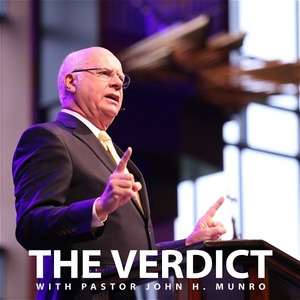
Today on the Verdict with Pastor John Monroe. Today, as we open the scriptures to Matthew chapter twenty-two, we're going to have the privilege of hearing Jesus Christ talking in dialogue to his critics. We're going to see that he silences them, and they're astonished. Welcome to the Verdict, featuring the Bible teaching of Pastor John Monroe. During his earthly ministry, Jesus faced hostility and opposition from the religious leaders.
But when he was confronted by their questions meant to trap and discredit him, the brilliant answers of Jesus silenced his critics. Today, we're looking at his powerful teaching on what it means to have a relationship with the living God.
So now, let's join Pastor John Monroe with today's lesson. How do you feel about conflict? Do you relish a confrontation, or do you find disagreements awkward and try to avoid them? We come to a passage of Scripture in Matthew 22, where the religious leaders are in conflict with Jesus. They're trying to find fault with him, to trap him, to expose him before the crowds as a false teacher or even a fraud.
Jesus silences his critics. I look on this passage as revolving around relationships. Jesus is going to explain that knowing God is a living and an eternal relationship. God is not the God of the dead, but the God of the living.
So let's join Jesus in conflict with his critics and see how he brilliantly silences them. Learn today what it means to have a living relationship with God. Jesus Christ said in a prayer to His Father, "This is eternal life, that they may know You, the only true God, and Jesus Christ, whom You have sent." That is, it is possible to know God, the eternal God that we've been worshiping, the Creator of the heavens and the earth, and the only way to know Him is through the Lord Jesus Christ. And that is the way, and the only way, to receive eternal life. This life, eternal life, everlasting life, is found only in our Lord Jesus Christ.
Today, our challenge is: Do you know the Lord Jesus Christ? Not just about Him, do you know Him? And in particular, can you say in your heart before God that you have a living? Personal relationship with Jesus Christ. Today, as we open the scriptures to Matthew chapter 22, we're going to have the privilege of hearing Jesus Christ talking in dialogue to his critics.
We're going to see that he silences them. But as we look at this passage, I want to think of this important, this fundamental point. That Christianity is having a personal relationship with Jesus Christ, and we're going to think of three aspects of that. As I say, Jesus is in conflict with his critics, and the first conflict relates to the resurrection. That is a very important question, isn't there?
Is there life after death? If so, what is that? If there is a heaven. How do I get into that heaven? If there is a hell, if there is such a reality as eternal punishment, how do I avoid going there?
Now, there are people who don't believe in life after death. They think when we die, we're just like the dog; we go into oblivion, and that's all there is to it. But I think most of us have great difficulty with that. That doesn't seem right, and there's certainly, of course, indirect conflict to the passage. We're going to read.
There were a group of men at the time of Jesus who didn't believe in the resurrection, and they bring a question to Jesus, and he's going to silence his critics. Let's open our Bibles then to Matthew chapter 22, and first of all, read from verse 23. Matthew 22, verse Twenty-three. The next day, Sadducees came to him, who say there is no resurrection, and they asked him a question, saying, "Teacher, Moses said, if a man dies having no children, his brother must marry the widow and raise up offspring for her brother, for his brother." Now there were seven brothers among us. The first married and died.
And having no offspring, left his wife to his brother.
So, to the second and third, down to the seventh, and then after them all, the woman died. In the resurrection, therefore, of the seven, whose wife will she be? For they all had her. That's the question: Who is the true husband in the resurrection? Because she's had seven husbands.
Verse twenty nine. Jesus answered them, "You're wrong, because you know neither the scriptures nor the power of God. For in the resurrection they neither marry nor are given in marriage, but are like angels in heaven. But as for the resurrection of the dead, have you not read what was said to you by God? I am the God of Abraham." And the God of Isaac and the God of Jacob, He's not a God of the dead, but of the living.
And when the crowd heard it, they were astonished at His teaching. A living relationship. A relationship with Jesus Christ is, first of all, a living relationship. The Sadducees' trick question, and of course it is a trick question, is designed to demonstrate the absurdity of the resurrection. The religious leaders have tried to trap Jesus in the past with political questions, with religious questions, and now these Sadducees ask a theological question.
Who are the Sadducees?
Well, their group—they're very wealthy. They're kind of the aristocrats of these groups. Very powerful, very wealthy. And the most important thing to know about the Sadducees is they don't believe in the supernatural. That's why they are sad, you see.
Sorry, but you'll remember. And in fact, they're so sad. We know historically that after the destruction of Jerusalem in AD seventy, they seem so sad that they stop existing. But they don't believe in the supernatural. In particular, verse twenty three, they came to him and say, "There is no resurrection.
They're materialists. They believe that the soul perishes with the body at death." We also know from Acts twenty three verse eight that the Sadducees don't believe in angels. They don't believe in spirits. And their question, this is rather skillful question, their tricky, slippery question, is based on the law of levirate marriage. You say, what's levirate marriage?
Well, you should know if you know your Bibles. Turn to Deuteronomy, the fifth book in the Old Testament, chapter twenty-five. The law of levirate marriage was designed to continue the first husband's name and inheritance if he died without children. A child then born to the husband's brother would then be given the first brother's name and inheritance. Deuteronomy twenty-five, verse five.
Here's part of the Mosaic law. Do you think this is a strange law? If brothers dwell together. Judith only twenty-five verse five, and one of them dies and has no son. The wife of the dead man shall not be married outside the family to a stranger.
Her husband's brother will go into her and take her as his wife and perform the duty of a brother's of a husband's brother to her, and the first son whom she bears shall succeed to the name of his dead brother and. That his name may not be blotted out of Israel.
So the question they ask is based on this law: a sequence of marriage, death, and remarriage. First brother dies; his brother takes the same wife. And so the Sadducees say this: these seven brothers, just one woman, and they all marry the same woman. I can imagine the Sadducees smirking. As they ask this question, this trick question, designed to show how the doctrine of resurrection is actually absurd.
One would have thought, you know, I five brothers. I would have thought after the death of two or three of my brothers to the same woman, I think I'd have run in the other direction, wouldn't you? But here's the point. In the resurrection, well, mercifully, after the seven brothers, the woman herself dies. I don't know if there's other brothers, but I'm sure they were relieved when she died.
But in the resurrection, here's the SAGUCCI's question: In the resurrection, when this woman gets to heaven and meets the seven husbands, verse twenty-five. Whose wife will she be? You have seven of them. We read the reply of Jesus, demonstrating that the Sadducees neither understand the word of God nor the power of God. They don't understand the power of God.
They're limiting God. The resurrection is very different from physical life on earth. It's not just a mere continuation of life on earth. In heaven, relationships are transcended. It's not that we're going to stop loving our wife.
Our relationships are deeper. They're far better. Says Jesus, "You will be like the angels in heaven." Incidentally, we do not become angels when we die. I hear that even from people who should know their Bibles. When we die and go to heaven, you don't become an angel.
I'm glad I'm not going to be an angel. I'm a child of God. I'm a son of God. I'm purchased with the blood of the Lord Jesus Christ. In a sense, we're in a better place than angels.
Angels have not been redeemed. Angels don't die. There's no need for procreation in heaven. You're limiting the power of God. There's no death in heaven.
Furthermore, says Jesus, you don't understand the word of God. Did you know that's what he said? Verse thirty-one. Which was said to you by God? Think of the high view that our Lord Jesus had of Scripture.
Scripture reading hundreds of years ago is given by the Spirit to you Sadducees, and after all, the Sadducees based their views on the first five books of the Bible, the Pentateuch, the writings of Moses. They believed that Moses was more authoritative than anyone else in the Old Testament, and they disagreed with the Pharisees in that regard. The Sadducees are arguing that in the writings of Moses there is no resurrection of the dead, and Jesus says, "You don't even know your Bibles. Have you never read what we call Exodus three, verse six, verse thirty-two?" And as verse thirty-one, as for the resurrection of the dead, have you not read what was said to you by God? Exodus three, the burning bush, the Lord appearing to Moses.
What does He say? The Lord is quoting from Exodus three here, verse thirty-two. I am the God of Abraham, and the God of Isaac, and the God of Jacob. He's not the God of the dead, but of the living. A brilliant question answer, isn't it?
They revered the law of Moses; they considered it a higher authority than any other teaching in the Old Testament. They're saying, "Well, Moses didn't teach resurrection," and Jesus is saying, "Listen, you're ignorant of the truth that Moses himself taught it. When God spoke to Moses in Exodus three, Abraham, greatly greatly revered, had been dead for many many years. But what does God say? I am, not was." I am present tense.
I am the God of Abraham and of Isaac and of Jacob. God is not the God of the dead; He's the God of the living. Abraham and Isaac and Jacob are still alive. I'm still their God. I have this living, eternal relationship with these men who believed in me through faith.
Furthermore, remember God's covenantal promises to Abraham and what we call the Abrahamic covenant. Promises which, in their fullness, have not yet been fulfilled, but Abraham, yes, in the future, is going to see the nation and all of the land that was promised to him. God, not the God of the dead, He's the God of the living. In fact, the living God raises the dead. Don't you love that statement?
He's not the God of the dead, but of the living. We say when a loved one has died, person's dead, and that's true. But for someone who's saved by the grace of God, God is still their God. God doesn't desert them. The relationship that we have through Jesus Christ is a living one.
It's an eternal one. If you don't believe in the resurrection, you have a god of the dead, not of the living.
Furthermore, Scripture clearly teaches that there is a resurrection, as Jesus said. But look back to Daniel, Daniel, Ezekiel, Daniel, Daniel twelve, verse two. There is a resurrection. Of the righteous and of the unrighteous, every single one of us, one day will be resurrected. Daniel twelve, verse two, and many of those who sleep in the dust of the earth shall awake: some to everlasting life, and some to shame and everlasting.
Contempt. Very clear, isn't it? John chapter five, teaching of Jesus. John five, verse twenty-eight. Gospel of John chapter five, verse twenty-eight.
Do not marvel at this, for the time is coming. Listen to this. When all who are in the tombs will hear his voice and come out, those who have done good to the resurrection of life, and those who have done evil to the resurrection of judgment. Yes, there's a resurrection. Every single person who ever lived is going to be resurrected.
But there's a fundamental difference, isn't there? There is a resurrection of the righteous and of the unrighteous, of the saved and of the unsaved. You say, John, how can I have such a living, eternal personal relationship with Jesus Christ, which will never, never end? We know that human relationships can come to an end and are broken, and it's very difficult when these relationships sever. But this relationship is a living and eternal relationship.
Listen to Jesus, who says, "I am the resurrection and the life. He who believes in me shall live, even if he dies. And whoever lives and believes in me shall never die. I am the resurrection and the Life. That's why followers of Jesus we don't fear death.
My relationship with Jesus Christ is not going to end when I die. My Lord Jesus Christ has promised I'll never leave you, John. I'll never desert you. This love, this relationship, is so strong that it never ends. Question is, do you have this living relationship?
A living relationship. Secondly, a loving relationship. Verse thirty-four, Matthew twenty-two, verse thirty-four. And when the Pharisees heard that he had silenced the Sadducees, they gather together. You can't argue with Jesus, can you?
He's totally silences them. And one of them, a lawyer, Pharisees. Different from the Sadducees, they know the law. They spend hours in the law with their minute interpretations and their traditions. They are very pedantic, particular attorneys.
And here is one of them. He's got a question. Ask him a question to test him, teacher. Although he's trying to test Jesus, he asks a brilliant question. Which is the great commandment in the law?
And he said to him, "You shall love the Lord your God with all your heart, and with all your soul, and with all your mind. This is the great and first commandment. And the second is like it: You shall love your neighbor as yourself. On these two commandments depend all the law and the prophets." A living relationship, yes, but this relationship with Jesus is also a relationship of love—a loving relationship. Love, Jesus is saying, is the fulfillment of the law.
Now, at this time, there's a debate among the religious leaders as to what is the most important of all the commandments. They had calculated, the Pharisees, that in the Old Testament there were 613 commandments. Whoa. That's a lot, isn't it? Particularly if you're a bit of a rebel.
Six hundred and thirteen of them, two hundred and forty-eight positive, and three hundred and sixty-five negative. Who wants a negative commandment, right? Thou shalt not. But there it was. And here's the debate with all of these commandments, negative and positive.
Which is the First, is it possible to reduce them to one axiom? Is it possible to reduce them to saying this is the greatest commandment? Jesus answers them. Yes, here it is: love God, and love your neighbor as yourself. All of Scripture.
Is in fact a commentary on these two commands, verse forty. On these two commandments depend all of the law and the prophets. You can reduce all of that law, all of the prophets. The prophets are only giving commentary on the law. They're trying to work out what does it mean to obey the Sabbath.
What does it mean when it says "thou shalt not steal"? And so you've got all of these writings, all of these other commandments. But this is central. All of the law and the prophets hang on these two commandments: love God and love your neighbor as yourself. Paul writes Romans thirteen, verse ten: "Love is the fulfilling of the law." If you love God, you love your neighbor as yourself.
You've fulfilled all of the commandments, and in evidence of your love for God. Is your love for others? How can you say you love God, whom you haven't seen, when you don't love your brother, whom you have seen? John's argument in one John, chapter four: Though I am to love God first, but I am also to love you. I am to love my neighbor.
But it is impossible to love my neighbor as myself unless I first love God. And it's impossible for me to love God unless He first loves me, unless I receive His love. That's John's argument in First John chapter four and five. It's not that we loved God, no, but that He loved us. And so, in the gospel, first and foremost, we are to receive the love of God through Jesus Christ.
And God's love is poured into our hearts through the Holy Spirit, who He gives us Romans five, verse five. And as we receive this supernatural love, now that I receive God's love, I am able through the power of the Holy Spirit to love God.
So when I sing, "Worthy," He alone is worthy. It's not just words; it's the expression of our hearts. Why? Because God loves us. And that love is transforming.
That love changes us, and we begin, however imperfectly, to love God with all our heart, with all our soul, with all our minds, and our strength, and to love our neighbor as ourselves. This is the verdict, featuring the Bible teaching of Pastor John Monroe. There's still more to hear when John returns in just a moment.
So stay with us. From matters of truth and identity to the subjects of love and grace, our world seems more confused than ever. But to find truth and certainty about who we are and find peace, we must turn our attention away from the world and look to the Word of God. To help you do that, John wrote a booklet titled "Eternal Security: Finding Certainty in a Chaotic World." Through this special resource, John shares his personal testimony along with a careful examination of Scripture to offer us clarity on matters of eternity. Get your copy today by visiting our website at theverdict.org.
While you are there, consider making an investment in this Bible teaching ministry. Whether it's five dollars, fifty dollars, or more, your gift today helps cover the cost of sharing these gospel messages to listeners around the world. And if you haven't already, be sure to subscribe to the Verdict podcast, featuring John's weekly podcast exclusive called Avizandum. It's available wherever you get your podcasts, or simply go to our website. Again, that's theverdict.org.
The Verdict is a ministry of Calvary Church in South Charlotte. We're located on the corner of Highway 51 and Ray Road. If you've been looking for a church home or a community to help you grow in your walk with Christ, we invite you to join us for our Sunday services. For more details about Calvary and our service times, visit theverdict.org.
Now, here's Pastor John Monroe.
Well, what's your verdict? Do you believe in the resurrection of the dead? I firmly believe it, as Jesus conquered death and still says, "I am the resurrection and the life." How wonderful to realize that we can know God, we can have eternal life, and this relationship with God through Jesus Christ will last forever. I pray that you today will place your trust in Jesus Christ and receive this eternal life. And don't miss next time, as we continue to think about the importance of a living relationship with God.
Thanks for joining us today on the Verdict. I'm Michelle Davies. Today's program with Pastor John Monroe was produced and sponsored by Calvary Church in Charlotte, North Carolina.