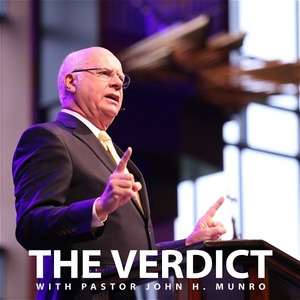
Today on the Verdict with Pastor John Monroe. Could it be that we are orthodox in our faith, but have no love for God, no passion for God? Externally very impressive, internally hollow. Jesus spoke of those in his days who honored God with their lips, but their heart was far from Him. Welcome to the Verdict, featuring the Bible teaching of Pastor John Monroe.
Unfortunately, many people today are simply going through the motions in their spiritual life. They may go to church or make a point to follow certain traditions, but there's no reality in their faith. Today on the Verdict, we're considering how to distinguish between authentic faith and hollow religion in our lives.
Now, to introduce today's message, here's Pastor John Monroe. One area of discussion, or even controversy, in churches today, is over the form and style of worship. There are traditionists who love hymn books and organs, and there are those who like to turn the church into a kind of rock concert with high energy and very loud music. Then there are those who say they're in between. Using different styles of music, whether it be traditional, contemporary, southern gospel, classical, or whatever.
But isn't it sad that so often the subject of worship comes down to our experiences, our wishes? We forget that worship is for God and not for us. Jesus taught us that we are to worship in spirit and in truth. Today we think of religion and external activity, but can it be described as worship to God? How would you describe your worship of God?
Is it authentic, or is it phony? Is it real, or is it based on ritualism? In the last book of the Old Testament, the book of Malachi.
Something tragic happens. Israel, as they're coming to the temple to worship God, are bringing polluted food and maimed animals. Instead of giving God their very best, they bring the worst. They bring that which they cannot use themselves, and present that in seeming worship. And the Lord says, "I'm quoting from Malachi, the last book of the Old Testament.
Oh, that there were one among you who would shut the doors, that you might not kindle fire on my altar in vain." The Lord is saying, "It would be better that, in fact, we close the doors of the temple, that you don't come to the temple to worship." Rather than giving your very worst spiritual activity, but no spiritual reality. In the last book of the Old of the New Testament, the book of Revelation, there's another tragic scene. There is a church in a place called Laodicea, and it's very active. There's a lot going on in the church. But the tragedy is that the Lord Jesus is outside the church, and John, in his revelation from the Lord, gives this picture of Jesus outside the church, knocking at the door.
He says, "I know your works; you're neither cold nor hot. Would that you were either cold or hot!" So, because you are lukewarm and neither hot nor cold, I will spit you out of my mouth. Religious activity without spiritual reality. What about you? What about us?
Could it be that we are involved as it were in a kind of religious ritualism without spiritual reality? Could it be that we are orthodox in our faith, but have no love for God, no passion for God? Could it be that we've got a lot of emotionalism without authentic worship? Externally very impressive, internally hollow. Jesus spoke of those in his days who honored God with their lips, but their heart.
Was far from him. Is that true of us? Is that true of you? Let's open our Bibles to the first Gospel, Matthew chapter twenty-one. We're going consecutively through Matthew, and today we come to the twenty-first chapter.
It's going to record what we call Palm Sunday. And first, we're going to look at verses one through eleven and learn this. You want to be blessed by God? Here is how it begins: by receiving Jesus as Savior and King personally. Matthew chapter twenty-one, verse one.
Now, when they drew near to Jerusalem and came to Bethphage to the Mount of Olives, then Jesus sent two disciples, saying to them, "Go into the village in front of you, and immediately you'll find a donkey tied and a colt with her. Untie them." And bring them to me. If anyone says anything to you, you shall say, "The Lord needs them," and he will send them at once. This took place to fulfill what was spoken by the prophet, saying, "Say to the daughter of Zion, Behold, your king is coming to you, humble and mounted on a donkey, on a colt, the foal of a beast of burden." The disciples went and did as Jesus had directed them. They brought the donkey and the colt and put on them their cloaks, and he sat on them.
Most of the crowd spread their cloaks on the road, and others cut branches from the trees and spread them on the road. And the crowds that went before him and that followed him were shouting, "Hosanna to the Son of David!" Blessed is he who comes in the name of the Lord. Hosanna in the highest. And when he entered Jerusalem, the whole city was stirred up, saying, "Who is this?" And the crowd said, "This is the prophet Jesus from Nazareth of Galilee." This is the time of the Passover, and Jesus enters Jerusalem. We have seen in the past that Jesus is on a journey with his disciples, going to Jerusalem, and now they enter Jerusalem, and he comes riding on a donkey.
Now Jesus had predicted that he's going to be condemned to death in Jerusalem, chapter twenty, verse eighteen. He says to his disciples, "See, we're going up to Jerusalem, and the Son of Man will be delivered over to the chief priests and scribes, and they will condemn him to death." He knows as he enters Jerusalem on this donkey that he's going to die. The crucifixion is only days away. This donkey and colt are prepared for the occasion. Verse three: The Lord needs them, and something wonderful happens.
As Matthew, who loves to quote from the Old Testament, five hundred years before this event took place, an Old Testament prophet, a man called Zechariah, had prophesied. That when the Messiah comes, he comes on a donkey. Don't you read that prophecy? It's found in the book of Zechariah, Zechariah nine verse nine. Rejoice greatly, O daughter of Zion!
Shout aloud, O daughter of Jerusalem! Behold, your King is coming to you. Righteous and having salvation is he. Notice this humble and mounted on a donkey, on a colt. The fall of a donkey is the Bible true?
Of course, it's true. Prophecy is fulfilled, and now as we look back at Matthew twenty-one, Matthew says, as Jesus is entering on a donkey, he said, "This took place." To fulfil what was spoken by the prophet, we've just read it, saying, "Behold, your king is coming to you, humble and mounted on a donkey, on a colt, the foal of a beast of burden." What an event! The king is coming. It's been calculated that this time of the Passover in Jerusalem, there's about one hundred and eighty thousand people. The place is absolutely packed.
The crowd, as they go to Passover, they're looking for national salvation, and notice what they shout in verse nine: "Hosanna, Hosanna in the highest! Hosanna to the Son of David!" Hosanna is a Hebrew word, it's found in Psalm one hundred and eighteen, verses twenty-five and twenty-six, and it's a term of joyful praise. It means save us, God save us, Hosanna in the highest. And as Jesus enters into Jerusalem, for those who have eyes to see and ears to hear, He comes as Savior. He comes as their King.
Oh, the excited crowd are looking for a political conqueror to overthrow the Romans. Remember that at this time. Israel is under the heel of Rome. Rome is the superpower, and they want to be liberated from Rome. And they have a misunderstanding of the identity and the mission of Jesus.
They do not realize that Jesus is the Christ. That He's the King, and He's come to deliver them from a bondage far greater than Rome's. Perhaps someone is thinking, a king. I mean, what kind of king and kingdom is this? A king is coming on a borrowed donkey.
Where are his armies? When Rome comes as a conqueror, they come with all of their pomp and their splendor and their armies and their horses, demonstrating their power. But of course, Jesus had talked about the kingdom of heaven. Oh, the crowd, Matthew says, is stirred up. But notice what they say in answer to the question, "Who is this one?" Oh, he's the prophet Jesus from Nazareth of Galilee.
They don't see the savior. They don't see the king. And they certainly don't understand that their king, that their Messiah, has come, to die, on a cross.
Now I know this verse twelve, and Jesus entered, the temple. And drove out all who sold and bought in the temple, and he overturned the tables of the money changers and the seats of those who sold pigeons. He said to them, "It is written, 'My house, notice that, is the house of God. My house shall be called the house of prayer, but you make it a den of robbers.'" And the blind and the lame came to him in the temple, and he healed them. But when the chief priests and the scribes saw the wonderful things that he did, and the children crying out in the temple, "Hosanna to the Son of David," they were indignant, and they said to him, "Do you hear what they're saying?" And Jesus said to them, "Yes.
Have you never read?" Out of the mouth of infants and nursing babies, you have prepared praise. And leaving them, he went out of the city to Bethany and lodged there. In the morning, as he was returning to the city, he became hungry. And seeing a fig tree by the wayside, he went to it and found nothing on it but only leaves. And he said to it, "May no fruit ever come from you again." And the fig tree withered at once.
Now, there is a strange thing.
Someone says, "Why would the Lord put a curse on a fig tree?" Was he doing that out of anger? Was he doing that out of spite? He comes to get some figs from a tree, and there's no figs on the tree. And so, in a fit of anger, he puts a curse on the fig trees. That was happening.
Does that sound like something Jesus would do? Jesus never uses his power. In a self-interest way, or in a way of pique, absolutely not. No, the cursing of the fig tree is a dramatic, acted-out parable of the judgment of God on Israel. The cursing of the fig tree is a prophetic sign that judgment is coming, and is given as a warning to Israel.
No, he didn't act out of anger. The cursing of the fig tree, and the cleansing of the temple, go together.
Now let's think of this. This fig tree has leaves, but it's got no fruit. Before the main season for figs, there are small green pre-figs. They're small. They're edible.
They're not particularly palatable, but these pre-prefixes appear before the leaves.
So this is Passover time, around March and April. A tree has leaves but no pre-fixes, and if that's the case, it's going to be barren for the entire season. Leaves on a fig tree at this season was normally a sign that there was fruit. There were figs, but not on this tree. The leaves are visible.
You go to the tree expecting figs, but when you come closer, you see in fact there's a lot of leaves, but there's no fruit. You getting the point? The fig tree is a picture. It's a picture of the spiritual condition of Israel: leaves, but no fruit. In the temple, there's noise, there's activity, there's ritual, there's emotion.
Ah, but there's nothing for God. Externally impressive, but internally hollow. Could that be true of a church? Yes, yes. Externally impressive, but internally hollow.
The temple built by Herod was a magnificent structure, dominating the skyline of Jerusalem and the surrounding area. Very, very impressive, but at the time of Jesus, the fig tree and the temple were the same. Leaves promising fruit, but none. Religious activity without spiritual reality. Rather than the temple being a center for worship and prayer, the temple is a place of religious ritualism, of business, yes, of exploitation.
For example, the time of the Passover, people had to offer a lamb, and the lamb had to pass the inspection of the priests for a charge. Many people brought. Animals themselves, or bought animals from the temple, as these animals were certified as acceptable, and the high priestly family, as it were, had a corner on the market, and they exploited the people, including the poor people. Once a year, a temple tax, a half shekel of silver, had to be paid.
So, in the temple, there's money changers. They're doing this in the court of the Gentiles to facilitate the changing of money, but they're doing that, of course, at a cost. They were doing it; nothing wrong with exchanging the money. A lot doing it to use that which is going for worship to line your own pocket. And the temple is like the fig tree; looks very, very good from afar.
But when you get close, you realize it's mere leaves, empty religion, lot of excitement, lot of activity, but no authentic worship, devoid of spiritual power and life. And Jesus says, "The temple is my house; it's to be a place of worship, is to be a place of prayer for all of the nations. It's not a place for making money." And did you notice the leaders were indignant at the children? Here, the the children. I think this is wonderful.
The children are crying out in the temple, "Hosanna to the Son of David!" These little children get it, but the powerful religious establishment. Don't get what the children are saying, and I've discovered that children—and you know this if you're a parent, you know this if you're a Sunday school teacher, if you're a teacher—the children, often very little children, they can grasp a spiritual truth, can't they? One that sometimes we, adults, kind of stumble over, but a child with a with a purity of faith often get the point, don't they? And these little children did. They are singing, and they're applying an Old Testament quotation to Jesus, the Son of David.
What insight! But here, in the temple, although the little children get it right, Jesus, the Messiah, the King, the Son of David, stands, and he's rejected by the very centre. Of their worship, plenty of leaves but no fruit.
Now notice what Jesus does. Jesus condemns the ritualistic religion. He condemns the hypocrisy, and he condemns the greed. Do you notice what he did in verse twelve? He drove them out.
That must have been an amazing scene. The poor, who could only afford pigeons, even the poorer, being exploited by these men, and they had turned, says Jesus, my house into a den of robbers. Think of it! What an indictment! Israel is looking for a Messiah to drive out the Gentiles, the Romans.
The Messiah comes, and he drives them out. He drives out the exploiters and the hypocrites, and those who are using the name of the Lord and religion to make money and to further their power. Base, condemned by Jesus. Can I quote from a Scottish theologian? Is that allowed here?
James Stewart. Here's a powerful quote from him. He says he Jesus was the meekest and lowliest of all the sons of men. Yet he spoke of coming in the clouds of heaven with the glory of God. He was so austere that evil spirits and demons cried out in terror at his coming.
Yet he was so genial and winsome and approachable that the children loved to play with him, and the little ones nestled in his arms. No one was half so compassionate to sinners, yet no one ever spoke such red-hot, scorching words about sin. A bruised reed he would not break. His whole life was love, yet on one occasion he demanded of the Pharisees how they ever expected to escape the damnation of hell. He was a servant of all, washing the disciples' feet.
Yet masterfully he strode into the temple, and the hucksters and money changers fell over one another to get away from the mad rush and the fire they saw blazing in his eyes. That's the majestic Christ, the meekest, the humblest of men, yet condemns the hypocrites and those who practice. Funny religion. Ah, but the cursing of the fig tree is an illustration to the nation and a symbol of the coming judgment on the temple. This was serious.
This is the verdict, featuring the Bible teaching of Pastor John Monroe. There's still more to hear when John returns in just a moment.
So stay with us. From matters of truth and identity to the subjects of love and grace, our world seems more confused than ever. But to find truth and certainty about who we are and find peace, we must turn our attention away from the world and look to the Word of God. To help you do that, John wrote a booklet titled "Eternal Security: Finding Certainty in a Chaotic World." Through this special resource, John shares his personal testimony along with a careful examination of Scripture to offer us clarity on matters of eternity. Get your copy today by visiting our website at theverdict.org.
While you are there, consider making an investment in this Bible teaching ministry. Whether it's five dollars, fifty dollars, or more, your gift today helps cover the cost of sharing these gospel messages to listeners around the world. And if you haven't already, be sure to subscribe to the Verdict podcast, featuring John's weekly podcast exclusive called Avizandum. It's available wherever you get your podcasts, or simply go to our website. Again, that's theverdict.org.
The Verdict is a ministry of Calvary Church in South Charlotte. We're located on the corner of Highway 51 and Ray Road. If you've been looking for a church home or a community to help you grow in your walk with Christ, we invite you to join us for our Sunday services. For more details about Calvary and our service times, visit theverdict.org.
Now, here's Pastor John Monroe.
Well, what's your verdict? What style of worship do you like? I'm sure you agree that it isn't so much a matter of style, but rather an attitude of the heart and of the spirit, in accordance with the Word of God. How sad if we attend churches where there is activity but no spiritual fruit. But we must personalize it.
It's all too possible to be busy with religious activity, but without spiritual reality. Keep your eyes on the Lord Jesus. Your love for Him will result in heartfelt worship and praise. Thanks for joining us today on the Verdict. I'm Michelle Davies.
Today's program with Pastor John Monroe was produced and sponsored by Calvary Church in Charlotte, North Carolina.