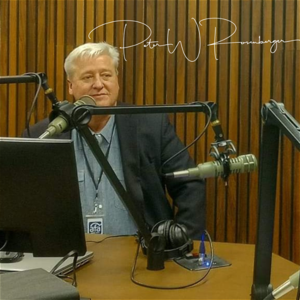
This is the Truth Network. Welcome to Hopeful Caregiver here on American Family Radio. This is Peter Rosenberg. Glad to be with you. This is the program for you as a family caregiver.
November is National Caregiver Awareness Month, so I am glad you are here. If you are not, A caregiver, and you just stumbled into this program, which you know is pretty normal for us. People just, you know, they have a flat tire or something, and they pull into where we are. That's okay. It's all right because if you love somebody, you are going to be a caregiver.
If you live long enough, you are going to need one.
So you might as well just enjoy the ride here for the next hour, and I'll give you some insights that I've learned over forty years of this thing, and what we can do to live a calmer, healthier, and dare I say it. A more joyful life while serving as a family caregiver. You you would think this is a very dire type of topic, and there are difficult components to it. Yes, I admit it's a it's a tough journey, but it doesn't have to be a miserable one. And these are things I've learned in my forty years of this, and there have been plenty of tears, plenty of hard things, plenty of challenges.
But at the same time, I also find plenty of beauty and joy and excitement, and things I've learned about life, love, faith, God, all of the above. And if you pull up a chair, I'll share some of those things with you today. Hope for the Caregiver dot com. Little programming note: I recently sat down with a wonderful. Interview with Benjamin Hall.
I really enjoyed talking with this man. He had me on his podcast with Fox News Radio, and he is the Fox News war correspondent who was in the vehicle with his cameraman Pierre Zakruski, I believe is how you say his name, and Alexandra or Sasha. Kushenova. It's hard. I don't know if I'm pronouncing her name right.
But sadly, both Pierre and Sasha were killed in that attack on their vehicle. He barely survived. He lost a leg, part of his foot, part of his eye, in his hand. Serious damage to his hand. Extensive burns.
I mean, it was a pretty brutal attack. And he had me on his program to talk about my journey, and I find him to be an incredibly gracious and fascinating man. And I enjoyed the conversation very much. It should be out in the next few days, and you can always just follow along at hopeforthecaregiver dot com. You can also go out to my Substack.
And I'll send notes out when it comes out at caregiver.substack.com, or you can go to any of our Facebook groups. Hope for the caregiver the Facebook group or hope for the caregiver page, and I'll post it out there as well. I think you'll enjoy the conversation we had. I enjoyed it immensely with him, and fascinating guy.
So anyway, that's a programming note. I want to. Start off with something. I was sharing this with our caregiver support group the other day that meets every week, and and I love this time I have with them. And and you can go out to the Substack and see the article about it.
Go to caregiver.substack.com, and you can see the article is called "Speaking Fluent Caregiver." And I mentioned to them that I was speaking in North Carolina a while back. And I get out of the airport. I get onto a shuttle bus to take me to the rental car place, and there's a guy driving. And I could tell by his accent. He greeted me as I got onto the bus.
Nice fellow. And I asked him. I said, "Where are you from?" Because I could tell by his accent, he wasn't from North Carolina. I grew up in that part of the the country in the Carolinas, and and I I'm familiar with the accent from the South. And he was from Kenya.
And and I remembered a few phrases in Swahili that I'd learned from classmates when I was in Bible college many many years ago down in South Carolina, and there were a lot of missionary kids that came in, and I'd try to pick up. Phrases and languages. I've done this for many languages. I don't know much of them. I do okay with Spanish.
A few things in French, Swahili. I learned a few things in Tree and Ewe over there in Ghana, and and other languages. I would like to learn more, but I do the best I can with what I have. But I try to pick up things and and phrases. And I greeted him in his language in Swahili.
And the look on his face. Was astonishing, and he—I mean, just—he erupted in a smile, and and he looked at me and he said, "How do you know my language?" And I said, "Well, you know, I try to pick up phrases when I can, and and to learn things to be able to speak to people in their own tongue." You know, and think about how difficult that is for some people to, and we want people when they come to this country to learn how to speak English, to be able to assimilate in, not to be segregated out because they can't speak a language. I want people to learn how to speak our language. I don't want to press one for Spanish if I am calling someplace. Just you know, let's all speak the same language if we can.
But at the same time, I don't mind learning. Things from other people and their cultures as well, and and trying to make those connections. When I travel overseas or into certain parts of this country, I I do try to learn the language as much as I can in the short time I have of the people that I'm going to be interacting with, simply so I can make those. Relationships and whatever we're doing, particularly you know with our prosthetic limb outreach and so forth, I want to be able to speak to them in a way they understand, and I appreciate when people do the same when they come to our country. But this guy, I just said simply Zuri Abadagani, and you know started speaking a few phrases to him in Swahili, and the look on his face was just, you know.
Astonished that some white guy, white stranger, getting onto the bus with him would stop and speak in his own language. But you know that's the way it is for us as caregivers. We go about our business. We're trying the best we can to to do what we need to do. But ever so often, somebody will surprise us and speak to us in a way that we can understand.
Even if it's just a simple greeting, in a way that speaks to the language of our hearts, I have friends that were with Wycliffe Bible Translators. I think they still are their entire career. I remember meeting them in college, and I've learned a little bit about how they do that with Bible translation. And they they go into a place. You don't start translating the Bible the first day you get there, you know.
You have to immerse yourself in the village. You have to spend some time with the people and understand them and their culture and the way they communicate, and then little by little start to build that understanding of how to communicate to them. If you go in the first day and start translating the Book of Leviticus, I promise you it's going to be an uphill climb. You have to spend time in the village, and that's what I do for family caregivers. I am kind of a A translator for caregivers.
I speak fluent caregiver, and so when you listen to this program today, you're gonna hear somebody that does speak in a way that you can understand as a caregiver. Maybe it's the first time you've ever been with us on this program, and I'm grateful that you are. I really am. I didn't have anything like this, so I made it. I created it.
I built it. And I remember going to a counselor one time. I was going through a real bad patch. And the counselor said, "I'd recommend a book for you to read, but you're the guy to write it." And I thought about that a lot. What would I say to my fellow caregivers?
And then I thought, "Well, what would I say to myself? And what language would I say it in?" And that's what led to this program. But I want to go one step further here. You know, I looked at this man and spoke to him in Swahili, and his face lit up. How do you know my language?
But that's what I hope. Happens when a caregiver hears this program somewhere between all the medications and the insurance calls and another sleepless night, the frustration, the weariness, the despair, the sadness, the grief, the loss—that you realize that somebody does speak your language, and you don't have to explain everything. I speak it because I've lived it for forty years. But consider what God does for us. I want you to think about this for just a moment.
John Calvin described God as lisping to us, speaking at a level we can understand, as someone would speak tenderly to a little child—goo goo gaga kind of thing. But that's what God does for us. He condescends to speak to us in a way that we can understand. Psalm one hundred three fourteen says, "For He knows our frame; He remembers that we are dust." And Hebrews four fifteen tells us that we have a high priest who sympathizes with our weakness. When we come to him, exhausted and unable to find the words, we come to the one who already understands.
In fact, what we really find out is that he already came to us. That's what Emmanuel means—God with us. He condescended to us. He speaks to us in a way that we can understand. I've learned to speak fluent caregiver, but here is the great news: it's our Savior's native tongue.
That's who He is—the ultimate caregiver of a wounded bride, and that is hope for this caregiver. This is Peter Rosenberg. We'll be right back.