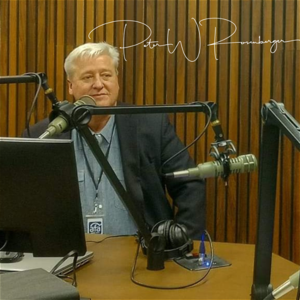
Welcome back to Hope for the Caregiver. This is Peter Rosenberg. Glad to be with you. Hope for the Caregiver dot com. Hope for the Caregiver dot com.
By the way, if you want to review what I just talked about in the last block about the Chinese rice farmer, I've got that out on my Substack. Caregiver dot Substack dot com. If you want to go out there, sign up for it's free. I put it out there. But again, it's talking about information that's available to you.
I'm putting out 40 years as a caregiver. Who do you know that's done this?
Okay, who do you know that's had that kind of experience that has put this kind of library out there? I've got about a thousand episodes on my podcast. I've got I don't know how many hundreds and hundreds and hundreds of articles that I've published out there, and I'm trying to put all this into a library there at my Substack.
So take advantage of it.
Okay, we've been talking. Periodically, hear about theology and the application thereof to caregivers, and and last week we talked about the doctrine of divine concurrence, which is God's sovereign work and our real responsible actions. God accomplishes His purposes through means, and our decisions and duties matter.
Okay, you go back and listen to that if you want to, and it's out at my Substack. This week. I want to continue our look at this with another doctrine. It's called the perseverance of the saints.
Now, these two doctrines have foundationally stabilized me, and I'm going to tell you why. And look, I know somebody's already thinking, Peter. I have insurance forms on the table. I've got to go and clean up something. I've got to do this and this and this prescriptions, whatever.
I got a loved one who didn't, you know, even go to bed last night. I'm tired, and I'm on my third cup of coffee. I get it.
So why are we talking about theology?
Well, because the waves are crashing.
Okay, the wind's howling, and caregivers need something solid beneath our feet.
Okay, I want you just hang on to that for just a second, because look, once you know how to do insurance, do you really need a lot of refresher courses on that? Once you know how to do laundry, do you really need a lot of? It's just something that's got to be done, but you're not like struggling.
Okay, how do I how do I deal with this? How do I how do I how do I wrap my mind around that? You don't think like that. What I mean, how many times do you need a refresher course to learn how to drive? And yet you'll pull out a it's.
Traffic that's going sixty, seventy miles an hour out here. The speed limit's eighty, and you do it. I don't even think about it. But where we live with stress and fear and worry and and anxiety, is wondering what's going to happen. How do we survive this?
How are we going to handle this? And we get knotted up in these things. And that's why I have been. Pushing myself to learn and study theology more.
Okay, what do I believe and why do I believe it? And what are the implications of that belief?
Okay, it's not just enough to say, "Okay, here's what I believe." All right, what is? Why do I believe this? And what are the implications as I take care of my wife? You follow me on that? Because a lot of people just spout off.
Well, I believe in God.
Well, okay. What are the implications of that? I mean, you you you can't you can't just do this.
Well, you can, but I mean, as caregivers, I have found for me that I can't just say, "Okay, well, here's what I believe." Okay, and just kind of go about my business. No, I need to understand why is this important. How did I arrive here? How did I get here? What what am I doing?
And what does this mean? You know, I remember having a conversation with somebody about end time stuff, and they were thinking this.
Okay, you got these signs are going on, and you got this and this, and the rapture may come here, and all that. Everybody, they were talking about this, and I finally stopped and I said, "They said, aren't you excited about all this?" And I looked at him and I said, "How does this help me take care of my crippled wife today?" Okay, now that kind of cut through the conversation pretty quick, and and that may offend some people. You know, deal with it because that's my reality. That is my reality. That is my lived experience.
Everything I do has to be in that regards. I don't say help me. I say help me, help you, help me, help Gracie. That's that's that is my whole focus. In okay, how do I Endure in this situation, and I'm not content to just survive it.
Go back and look at the Apostle Paul in in Timothy when he's saying, you know, I have been poured out like water, but I've fought the good fight, I've kept the faith. I'm not interested in just getting through this. I want to show myself approved. I want to get like I talked about in the last block the maximum yield. What can I do to be productive in this?
And that starts with what do I believe? Because what I believe, those questions I mentioned earlier: What do we believe? Why do we believe it? What are the implications of those beliefs? Those questions they follow me into every emergency room.
Those questions sit beside me when the house finally gets quiet. Those questions are sitting right beside me when the doctor says there's something else we need to discuss. When I looked at that diagnosis earlier this year of me having cancer, I was in my studio looking at my online chart, and I saw something that rhymes with the word aroma. And I was like, Christian, what do you believe? If my understanding of God cannot accompany me into those places.
Then I need to examine my understanding of God. Theology means the study of God. We all have some understanding of who He is, what He does, and whether He could be trusted. The question is whether that understanding is true, whether it's accurate. I wrote about this when Billy Crystal recently talked about he doesn't trust God anymore.
He doesn't talk to him because his friends Rob and Michelle Reiner were killed by their son. His home burned in the Palisades fire, and he's just kind of washed his hands of it. And so, he's obviously acknowledging that there is a God. He just doesn't trust him. Doesn't want to talk to him.
All right.
So, what do we do with that information? And I wrote, by the way, I wrote about that. It's called Room to Grieve, and I would really recommend you taking the time. To read that, I mean you don't have to, but I'm putting it out there so that you can go into whatever field you're working in and get the maximum yield, and you're not having to figure these things out the hard way like I did everything. But that's your decision.
But anyways, caregiver dot substack dot com. But we're exhausted on a given day. And when we're frightened, exhausted, grieving, we need truth that's strong enough to bear what we're putting on it. Will it? Will it?
Will it stand?
So let's let's consider this question today. Will Christ keep the people He saves? Will Christ keep the people He saves? All right.
The perseverance of the saints teaches that every one truly united to Christ by saving faith will be kept by God's grace and will continue in faith to the end. Saints means God's people, ordinary believers, people who need forgiveness, who struggle, who repent, who depend upon Christ.
Okay, that doctrine includes both God's keeping and our continuing. We persevere because God preserves us. That matters because the word perseverance can sound like another assignment for for us as caregivers. I mean, we're already warned: slam out, keep going, try harder. Don't don't let anybody down.
Don't let God down. We've heard plenty of that. But the foundation of this doctrine is God's faithfulness, not ours. It's His faithfulness. The Christian's future rests upon the Savior who died, rose again, and continues to intercede for his people.
Now, this this connects directly to what we talked about last week.
Okay, God's work does not make our actions meaningless. His grace brings about real faith, real repentance, and real endurance in His people. We believe. We pray, we turn from sin, we keep coming to Christ, and underneath those actions is the sustaining mercy of God.
Now, this promise concerns our salvation. It does not guarantee that a caregiver will avoid exhaustion, or that we're going to avoid illness, or depression, or even the need for help. The perseverance of the saints does not require the uninterrupted availability of the caregiver.
Now, where does this where does this teaching come from?
Well, I'm glad you asked. Scripture, the church's confessions summarize what we believe. Scripture teaches that's the creeds and so forth. But those creeds have to be tested by scripture. Look at John chapter ten.
Jesus describes his sheep as people who hear his voice and follow him. Then he says, "I give them eternal life, and they will never perish." John ten twenty eight. Then then he goes on to describe their safety in his hand and in his father's hand. Notice who gives the life. Notice who knows the sheep.
Notice who holds them, and notice that the sheep follow. Him, the promise never separates belonging to Christ from following Christ. Let's go to Philippians chapter one, verse six. He who began a good work is faithful to complete it to the day of Christ Jesus. Our confidence rests in the one who began the work and finishes it.
First Peter, same thing. Go go through it. Romans eight takes us through the suffering and the weakness and the groaning of creation awaiting redemption. Paul doesn't pretend that the Christian life is painless. Yet the chapter ends with the conviction that nothing in all creation can separate God's people from His love in Christ Jesus.
The suffering is real. The security is real. They appear in the same passage.
So when did Christians begin discussing all this? When was it codified?
Well, this was long before the Reformation. When Augustine wrote about perseverance as God's gift, and he addressed it extensively in the fifth century. He wrote a work called "On the Gift of Perseverance." Augustine's entire account of grace and assurance is not. Though identical to the later Reformed position, okay.
So let's be. I want want to be clear on that. But the question of God's gift of enduring faith certainly did not begin with the reformers and specifically John Calvin. Let's go to the Heidelberg Catechism. It was first published in 1563, and it begins by asking about our only comfort in life and death.
I love this. Its answer centers on belonging to Christ, who has paid for our sins, preserves us, and makes us willing to live for Him.
Okay, the Synod of Dort, D O R T, in the Netherlands in 1618 and 1619. Address disputes over salvation and grace. In the fifth main section of its canons, specifically addresses the perseverance of the saints. The Westminster Confession, completed in 1646, devotes Chapter 17 to this doctrine. It teaches that those truly accepted in Christ and sanctified by His Spirit cannot fall totally and finally from grace.
Totally and finally, those words matter. The confession acknowledges that believers can fall into serious sin and suffer terrible, terrible consequences.
Now, this confession is not without controversy. We'll talk about this in the next block. But let me leave you with this before we go to the break: If he saves you, he can keep you. This is Peter Rosenberg, and by the way, that's hope for the character. It's hard to count how many times I brought Gracie home from the hospital.
Sometimes she still needed a level of care that would overwhelm plenty of people, but the medical staff believed I could take care of her. Once I brought her home with oxygen, three drains, a catheter, and yes, two prosthetic legs. That's a tall order for anybody. Trained professionals do this every day, but what about family members who suddenly find themselves responsible for all of it? How did I get here?
How am I supposed to do this? Who's going to help me?
Well, if you listen to this program or read my books, you know what I've learned, often the hard way. But how many caregivers haven't heard? How many are struggling alone? Will you help us reach them? Standing with Hope has two program areas: a prosthetic limb outreach for Gracie's fellow amputees, and a family caregiver outreach for my fellow caregivers.
It's for the wounded and those who care for them. We don't have a fundraising budget. We want every dollar possible going to the work.
So I'm asking you directly: if you find value in this program, please help us put it within reach of another caregiver. Give today at standingwithhope. dot com slash giving. Standingwithhope. dot com slash giving.
Welcome back to Hope for the Caregiver. This is Peter Rosenberg. Glad to be with you. Hope for the Caregiver dot com. Hope for the Caregiver dot com.
Before we get back into our regular scheduled program, I got to tell you all something. We live out in the country.
Okay, we're backed up to the forest, and we've been overrun with mice, and I've been trapping them. Right and left. I mean, it's just we live in this old cabin. The new part we just built and remodeled, you know, is nice and tight and sealed up and everything else. But the old part, not so much.
And it was built in 1895. And who knows? I've tried to find all the access points and I've sprayed stuff and everything else. And we had two cats, but when we spent all the time in the hospital last year. They they departed, absconded, fled.
I don't know where they are. I mean, they could be somebody's dinner. I have no idea. We had they've been here for a while. I never even they were just kind of they just kind of showed up one day, and one of them was a smaller orange cat, the other one was a fatter one, so I just called them Fat Cat, Skinny Cat.
They stayed out in the barn, but they kept the mice away.
Well, I've been trying to get some new cats, and I had the word out. And a friend of ours, who's a nurse, she had helped take. She helps take care of a lot of people in this community, and just a wonderful lady. And she's been keeping her ear to the ground for me. And there was a guy that she was going to take care of, and end up passing away.
And his family's in town, trying to get rid of all of his stuff there and sell everything. And they had a bunch of feral cats out there by the barn, and they trapped them. And they said, "Do you want any?" And so.
So I went over there immediately. She said they're in the trap right now. If you want them, so I went over there Sunday night and got two of them, and I was very excited.
Well, the guy called me the next morning; he had three more, so I have five cats now, and I am going to keep you posted on how this goes because these and these are cats with that that are not friendly.
Okay, you have to trap them and. I mean, I got blood in the bed bed of my truck where they were scratching, trying to get out of the the cage, just to be able to get here to our place. They're they're not well adjusted people cats, but that's what I wanted. I want cats with bad attitudes. I want cats with family issues that you know are still struggling with it, and maybe a couple of piercings and some tattoos, and you know.
I want mean cats because we have a lot of mice and a few rats in the barn, and so I got them home. and I was so excited. We have five cats of the apocalypse now. We're gonna have a mouse again, and I am hoping so. And I told the cats, I said, "I'll give you a little bit of food because nothing's too good for these cats." So I got a little family dollar food that I put out there for them and some water.
That's just the appetizer. I said, "If you want the buffet, the fields are gray with harvest." Make yourself at home.
So, I'll keep you posted on whether or not the five cats of the apocalypse will do their job or not. Who knows? But anyway, we're going back to our study on the doctrine of the perseverance of the saints, not the perseverance of the cats, but. Christians disagree over a lot of things about this. The Westminster Confession, as I'm seeing in the last block, teaches that believers can fall into serious sins and suffer terrible consequences.
And I want to make sure I distinguish between that because we're talking about salvation, and I'm presenting the Reformed understanding because I believe it best accounts for these promises and the whole counsel of Scripture. But I want to give Three objections that people often give to that: Doesn't this give people permission to sin? It would if we were teaching that a a religious profession guarantees heaven regardless of whether a person trusts or follows Christ. But that's not the doctrine here. The promise is that God preserves his people in living faith.
He also disciplines them and brings them to repentance. Grace changes the people; it saves. In Romans six, Paul confronts the suggestion that we continue in sin so that grace may abound, and he rejects it emphatically. And we caregivers need to hear. My exhaustion does not give me permission to act inappropriately.
The pressure on me does not make me violating God's directives justifiable. If I wound somebody, I need to repent and, where appropriate, make amends. God's keeping gives me. That reason and that impetus to come into the light, where I can confess my sin to a faithful Savior.
So that's objection number one. Second objection: What about people who appeared to believe and then walked away? And that is painful. And these are sometimes people we love. And First John nineteen describes people who.
His departure revealed they had not truly belonged, and Jesus' parable of the sower also describes an initial reception that does not endure. And those passages teach us that outward profession and inward regeneration are not identical. There are people that could that profess this, and there are going to people that say to him in the last day, "Lord, Lord, didn't we do this?" He said, "I don't even know who you are. I don't know you." We should also be very Cautious about announcing the final spiritual condition of someone whose story is still unfolding. We don't know.
I can't inspect another person's heart. I keep praying, speaking truth, and calling people to Christ. But I've got all I can deal with with just me.
Okay. And then the third objection is, what about the Bible's warnings? Hebrew six and Hebrew ten contains very sober warnings about falling away, and and we shouldn't try to somehow make them sound like they don't have any force. In Hebrew six, the writer describes people who have experienced extraordinary spiritual privileges and then then then repudiated Christ. The reform interpreters differ on some of the details, but they.
Commonly distinguish these privileges from the saving union with Christ that endures. They point to to verse nine, where the writer expresses confidence that his hearers possess the things associated with salvation.
So, what we're going to find is there is a difference between professing and possessing.
Okay, that's that's the big difference right there. A lot of people profess. But professing is not the same as possessing. the the Do you follow me on that? the The broader reformed answer there in Hebrews to what Hebrews is talking about is that God uses warnings to, as a means to keep His people watchful and dependent on Him.
The warning is part of His preserving care, and in the canons of Dort, there that I was mentioned earlier from the Netherlands, explicitly include biblical warnings among the means that God uses to sustain believers. And other Christians understand these passages as warnings that genuinely regenerate believers can finally fall away.
So I'm acknowledging there's some disagreement there. I land on the side that if he saves me, he can keep me. And why is that important to me as a caregiver? First off, I'm not casual about abandoning Christ at all. In fact, I'm more intense about holding onto that than I was before I came to understand this.
But I think for me, I go to Peter. In Luke twenty two, what does Jesus tell Peter? He said, "Satan has asked for permission, demand it, even to sift him like wheat." Jesus said, "What I've prayed for you that your faith may not fail." And then Jesus also tells Peter that when he turns, when he comes through this to strengthen his brother, Jesus knows the denial is coming. He tells that to Peter. Peter, of course, says, "No, there's no way." But he also speaks of Peter's return, and he does fail.
Peter fails grievously. He he denies knowing the Lord. He he weeps bitterly. Yet his failure will not be the final chapter of his discipleship. And let me tell you something.
I I take that rather personally. I I really hold on to that passage. And Peter's restoration rests upon a Savior. Whose knowledge of of Peter and his weakness was complete before Peter ever discovered it himself. Jesus said, "This is what he's asked.
Satan has asked of demanded, but I've prayed for you.
So where's the confidence? Is it confidence in Peter, or is it the confidence in the effective prayers of a righteous man? Who is no one is righteous but Christ. The only righteousness we will ever have is from Christ, not our own." So Jesus's confidence is in his own prayer, and righteousness, and the work of his Father and the Holy Spirit on Peter's behalf, not on Peter's figuring this thing out. And and so I say to you, caregiver to caregiver, our confidence is not in anything we can do.
Our confidence is that we have one who is praying for us, one who saves us, and one who will keep us. June twenty four. How many times you've heard this?
Now unto him who is able to keep you from falling, there it is again. You know this is the everything is about Christ. It's always about Christ, and and then the Apostles' Creed confesses resurrection and everlasting life, and then Christians across all kinds of traditions affirm those promises. The reform doctrine explains how God brings His people to that promised end, and then we've been singing about this for years. And there is some people say, "Well, yeah, you know, you, you, you've got that wrong." And this, but then think about the songs that you sing: "Amazing Grace, how sweet the sound that saved a rich like me." 'Twas grace that brought me thus far, and grace will what?
Lead me home, grace will lead me home. Not me, not my efforts. I am not. I am not doing this. It's grace.
And the implication John Newton is offering you there is, it's his grace that's leading us home. You know, many of us have sung that hymn a bazillion times, but I think about what you are singing. The grace that rescued us will sustain us the rest of the journey. How firm a foundation! The the final stanza rests on a soul resting on Jesus, while all the powers of hell try to shake it.
The answer is God's promise: never, no, never to forsake that soul. Come, thou fountain of every blessing. the The text says, "Prone to wander, Lord, I feel it. Prone to leave the God I love." You know, we we we we recognize this. This if it was up to us, we would already be gone.
Augustus Toplady, who wrote "A Debtor to Mercy Alone," speaks of God's work enduring and of a a name that cannot be erased from His hands. I just go through him after him after him. What are the implications for a caregiver? What are those implications? First, we can we can distinguish our standing in Christ from our changing sense of assurance.
By the way, that's another one. Blessed assurance.
Well, who gives the assurance? When the waves crash, and they do, and when the winds howl, and they do, we need to know whom we are trusting. How are you going to function if you don't know what God has said? How are you going to function if you don't understand what His promises mean for the next ten minutes when you're in the middle of all this stuff? In John chapter seventeen, Jesus prayed for those that the Father gave him, and he included those who would believe through the apostles' words.
Hey, that's you and me. That's you and me. In John ten, Jesus says that no one can snatch his sheep from his hand. Hey, that's you and me. Caregiver, let me tell you this.
The hands carrying you and me bear the scars of our redemption. You can rest in the Savior who keeps you. He's going to bring you home. He's going to bring you home, and that is hope for this caregiver. And I want it to be your hope as well.
This is Peter Rosenberg. This is Hope for the Caregiver. We're going to be right back. Welcome back to Hope for the Caregiver. This is Peter Rosenberg, and I am very, very glad to be with you.
Hope for the Caregiver. dot com. And if you found what we're saying here today to be helpful to you, please take a moment to go out there and get involved, sponsor this program, and help us do more. Hope for the Caregiver. dot com.
We've been talking about the doctrine of the perseverance of the saints, and I really grab hold of that. There's two doctrines that have really sustained me over the last several years. One of them is this doctrine, the doctrine of the perseverance of the saints, and that He preserves us so that we can persevere. And the other one is the one we talked about last week, which is the doctrine of divine concurrence—that His will will not be thwarted. Do you realize what a great comfort that is—that we belong to Him, and He's got this.
Now that doesn't mean we're not going to go through painful things, because you wouldn't be listening to this program, and I wouldn't be doing this program, if we didn't have very painful things in our life. But I also wouldn't be doing this program if God and His mercy hadn't taken me deeper than those things. Remember that there's a great line, and I love this so much from the Chronicles of Narnia, when the White Witch felt like she had won by killing the Great Lion Aslan, and. She said, "You know, the the deep magic must be adhered to. That law of the deep magic, you you it has to be satisfied." Aslan willingly gave up his life.
You know, he's the Christ figure in this. And then when he came back from the dead, Lucy and and and Susan were looking at the the two Pevensy girls, and they were looking at him and saying, "You know, how how?" And he said, "Look, I'm paraphrasing C.S. Lewis here, okay?" He said. She saw the deep magic, but there was deeper magic. Basically, that's what he said.
There was there was magic she didn't see. She didn't go deep enough. That's what I'm talking about here. We we we'll stop and say, you know, well, God sent His Son. We'll stop at John three sixteen, for example, sent His Son, and we we we we believe this in our head, but when we're in the ICU, we're wrapping our minds or trying to wrap our minds around these things.
And that's when we need to go deeper. We need to go deeper, knowing that He's waiting for us in those deep places where we come to a point where we say, "Christian, what do you believe, and why do you believe it, and what are the implications of you believing this?" And and I am not content to live my life as a caregiver, just as a human being. Just mindlessly, just surviving through the day. I'm going to ask these hard questions, and I'm going to wrestle with them. I'm going to keep wrestling with them until I find a solid piece of land to stand on, and I have done that.
And now I'm telling others what it is I've found, what it is I've discovered—the deeper magic, if you will—that solid bedrock. I need no other argument. I need no other plea. It is enough that Jesus died, and that He died for me. Go back to the hymn writers.
That's why I love these hymns so much, because they they wrestle with these things and put it to prose that we can remember. On, on Christ the solid rock I stand. All other ground is sinking sand.
Okay, what does that mean? What are the implications? I just told you earlier in the program about amazing grace. We've been singing this. A lot of people say, "Well, you know, we could lose our salvation." Twas great, but they'll go right into singing "Amazing Grace." Twas grace that brought us this far, and grace.
Will lead us home. Who's doing the leading? Do you see? John Newton understood this. He understood this.
He's the one that's doing the saving. If you think you are bringing something to the equation of your salvation, you are in for a rude awakening. What? What part of the salvation is is my part? The only thing I bring to it is the sin that required it.
He does the saving. Go back and look at Lazarus. Lazarus is lying in the tomb.
Now, Lazarus did come forth. He did. He walked out of the tomb, but but he didn't walk out until when Christ summoned him, raised him from the dead by the power of the Holy Spirit from the Father. Lazarus, come forth. Peter, come forth.
It's the same thing. You see it now. It he makes us willing to be willing. But in of ourselves, we're not. We're dead.
We're we we we're dead. What part of I heard a seminary professor used to take his students out to the graveyard and say, "Okay, preach your best sermon and see what happens." Unless the Holy Spirit regenerates the heart, they're not. I don't care how many verses you play of "Just as I am." It doesn't matter. That it's irrelevant. Because that's not what's doing it.
It's not like you're trying to convince them of this. That's why it takes all the pressure off of us to simply bear witness to what we know. I know a lot of people who witness to people, or at least they say they do. But if you ever notice, they kind of witness at people. They're they've got a script and they're trying to win an argument.
They're trying to convince you of this. I don't have to convince you of anything. All I have to do is be faithful to tell you what God has done in my life. Let me tell you about what I was, and what I am now, and let me tell you what made the difference. Let me tell you about the redemptive work of God through Jesus Christ.
That is the whole point of this. They overcame by the blood of the Lamb and the word of their opinion, their script, their sales pitch, their apologetics. No, their testimony, the first-hand knowledge of what they have experienced through Christ. I remember a lady called in. I was doing a kind of a drop the needle, and I was playing a hymn, and and I was playing.
He touched me, and I was getting folks to call in. Is oh, do you know this hymn? And a lot of people called in. Oh, they love this hymn. They love this.
They love that. And this one lady called in. She's from North Carolina. Never forget her. And I said, tell me why you love this hymn.
And she said, oh, I used to be one way, and I ain't that way no more. I thought, man, that's about as good a representation of the gospel as I've heard. I used to be one way. I ain't that way no more, and that's it.
So, with that in mind, I also want to do our hymn today. We're going to go to the caregiver keyboard here, and it's a hymn that I did. About a couple of months ago, but I'm going to do it again because it works so well with what we're talking about today.
So let's go to the caregiver keyboard, and I'm going to play this for you. You sing along if you know it. When I fear my faith will fail, Christ will hold me fast. When the tempter would prevail, He will hold me fast. I could never keep my hold through life's fearful path.
For my love is often cold. He must hold me fast. He will hold me fast. He will hold me fast. For my Savior loves me so, He will hold me fast.
Sing it with me. Those He saves are His delight. Christ will hold me fast. Precious is On His holy side, He will hold me fast. He'll not let my soul be lost.
His promises shall last. Not by Him at such a cost. He will hold me fast. He will hold me fast. He will hold me fast for my Savior loves.
Crush me slow. He will hold me fast. All my life in hand. Crush will hold me fast. Justice has been served.
He will hold. We'll be fast, raced with him to endless light. We will be fast till our fateful time to sight. When he comes, at last, we will be fast. We will be fast for my saving master's song.
We will be fast. We will be fast. He will hold me fast, for my Savior loves me so. He will hold me fast. Well, that was nice having you sing with me, Gracie.
Oh, thank you. We're gonna have to do that a little more often now that we're starting to learn how to do it. It's nice for you to start singing again. You're getting better. It's been a long couple of years, but isn't that a great song?
Yeah, I love that. You know, I've been talking about on this program today the doctrine of the perseverance of the saints. If He can save me, He can keep me. Praise God! Does that does that sustain you?
Yeah. Thanks. I'll let you get back to your whatever it is that you're doing, Grace. Thanks for popping in. Whatever that is that I do.
How about I just wrap the show up? All right.
Thank you, baby. You're welcome. Thank you. I appreciate her being able to be a good sport and drop in on this. And I hope to have more of her back on here to sing because she's better at it than me.
If he could save you, he could keep you. The doctrine of the perseverance of the saints—that is hope for the caregiver. Hope for the caregiver. dot com. Go out there today and get involved.
We'll see you next time.